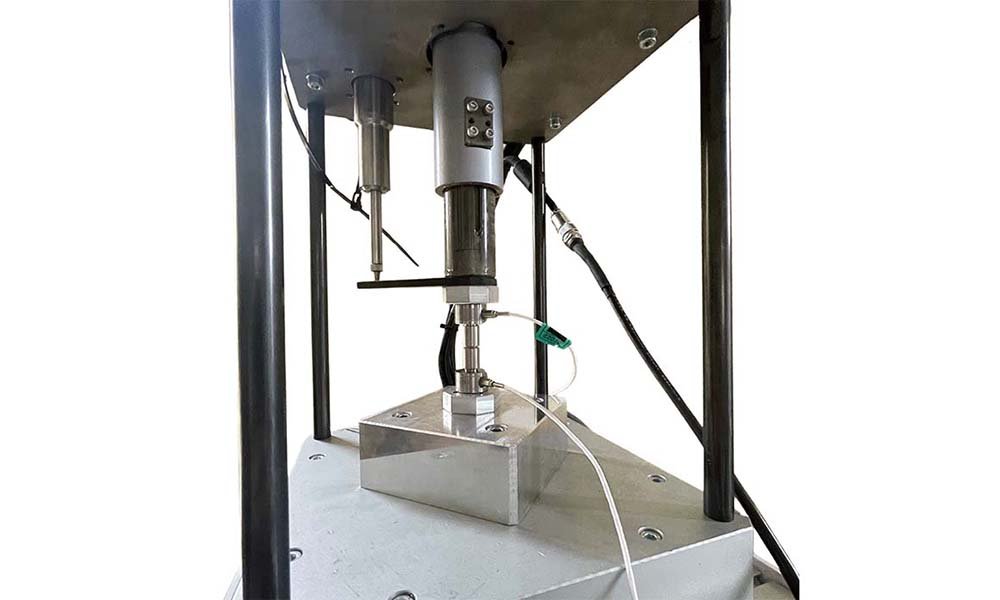
Adding a high-precision load cell to a Coretec servo press dramatically improves the performance of the CORETEC WPS “Work Explorer” feature.
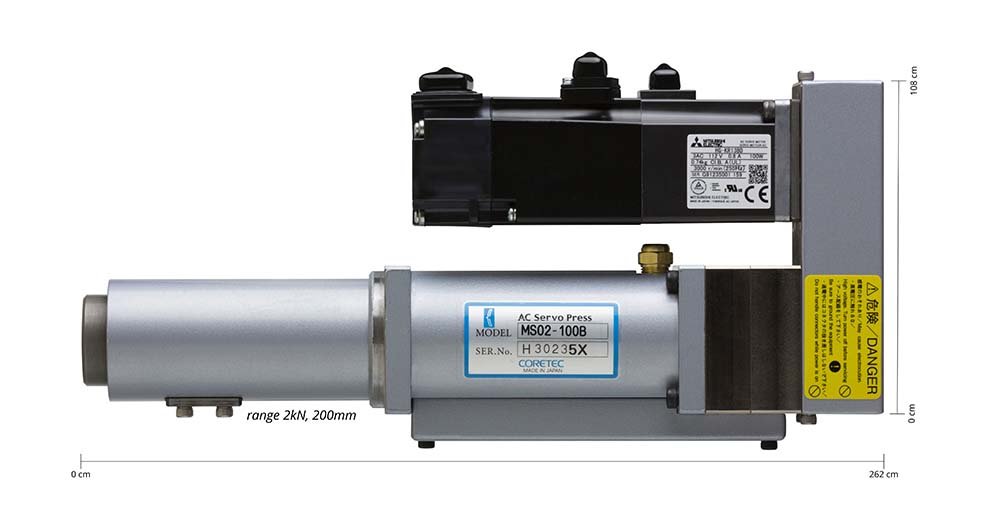
Coretec tools (for example the GS and MS servo press series) are highly sophisticated measuring instruments.
They don't just push, they analyze:
Work Explorer Function:
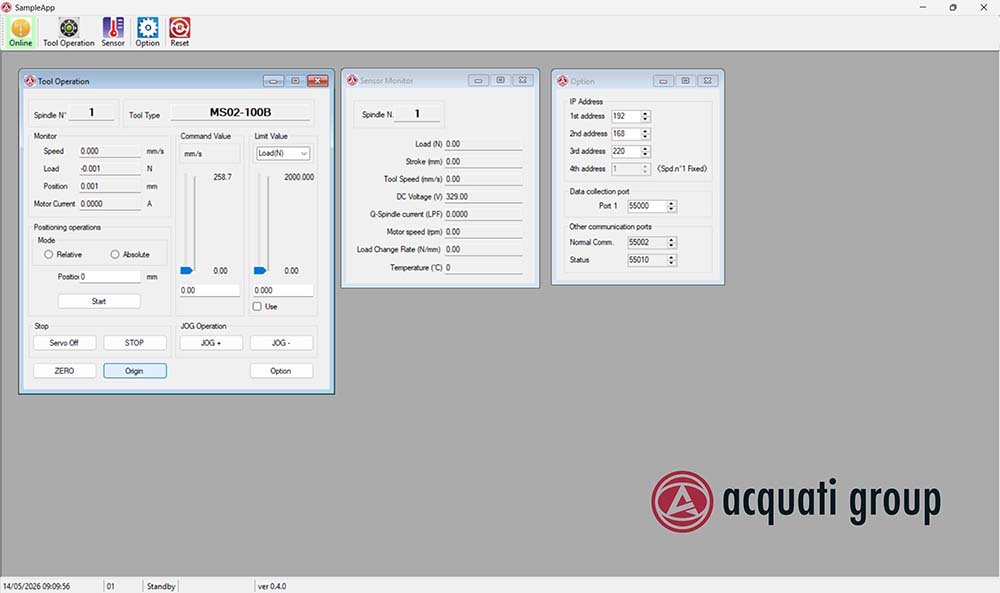
Coretec controllers feature a Work Explorer mode. This allows the punch to move at a specific search speed until it detects a minimal change in force (contact). It then records the exact position, effectively acting as a contact probe.
High sampling rate:
Coretec is known for its ultra-high-speed data processing (over 1000 samples/sec), which is essential when using the servo press as a probe to ensure the trigger point is accurately detected.
Improved features:
1. High sensitivity to contact (trigger point). The standard load cell integrated into a servo press is sized for the maximum capacity of the machine (for example, 5 kN). For this reason, it does not have the resolution necessary to detect very small contacts.
Advantage: An external sensor can be specifically sized for the probing phase (for example, to detect a 0.5 N contact on a 5 kN machine). This ensures that the servo press stops when it touches the surface without deforming the part, providing a much more precise zero-point measurement.
2. Eliminate internal friction (noise). Internal sensors must account for the friction of the ball screw, motor bearings, and seals. This mechanical noise can mask the actual force at the tool tip.
Advantage: An external sensor mounted directly on the tool measures only the force applied to the workpiece. This clean signal allows the Coretec Work Explorer function to activate with much greater repeatability, as it is unaffected by heat, wear, or the internal mechanics of the servo press.
3. Micron-level dimensional accuracy. When using a servo press as a probe, you often try to calculate a relative dimension (for example, measuring the height of a component to determine how much shim to insert).
Advantage: Since the calculation is Force + Displacement, any error in the force detection results in an error in the recorded position. A more accurate sensor reduces this uncertainty, allowing for tighter assembly tolerances that are impossible to achieve with a standard internal sensor.
4. Direct traceability. In various industries, such as medical device manufacturing and the aerospace industry, servo presses are often considered measuring instruments.
Advantage: It is significantly easier to calibrate and certify a high-precision external load cell to international standards than to calibrate the entire internal drive system of a servo press.
Coretec with external sensors:
The WPS controller is designed with high-speed analog inputs to specifically handle this external sensor, making it very easy to implement a high-precision secondary force feedback loop.
Sandvik coromant returns to bi-mu 2026 with an entirely digital booth.
Sandvik Coromant, a world leader in metalworking and manufacturing solutions, will return to BI-MU 2026 from October 13 to 16, 2026, at Fiera Milano. The company's participation strengthens its position as a technology partner in the transition to connected, data-driven manufacturing. BI-MU 2026 is an international trade fair dedicated to the machine tool sector, bringing together professionals and decision-makers from across the manufacturing sector. The event serves as a key meeting point for presenting innovations in industrial manufacturing and advanced production technologies. As part of its renewed presence, Sandvik Coromant will be exhibiting in Hall 22, among the machine tool manufacturers, with a completely redesigned booth concept (Stand E10). The company will present a fully digital booth designed as an immersive experience, going beyond the traditional product display to focus on integrated solutions, software, data, and value-added services. The booth was designed as an interactive environment where visitors can interact through digital demonstrations, interactive screens, and displayed application examples. Rather than a conventional exhibition space, it will function as a technical consultation area designed to foster discussion, simulation, and a deeper understanding of manufacturing challenges and solutions. Through this approach, Sandvik Coromant aims to make digital and software-based manufacturing solutions more tangible and accessible, helping visitors explore how integrated technologies can improve performance and process control. A key focus will be CoroPlus® digital machining solutions, which will highlight how data-driven capabilities can support process optimization, improved tool and software integration, and greater control of manufacturing operations. The company will demonstrate how this approach enables manufacturers to improve productivity, operational efficiency, and process predictability. This evolution reflects Sandvik Coromant’s broader transformation from a tool supplier to a technology partner in connected manufacturing, supporting the development of digital and flexible manufacturing environments based on data, performance and process control. Additionally, Sandvik Coromant will participate in the BI-MU FutureTech competition, the official initiative that recognizes innovative solutions presented at the fair. This participation underscores the company's commitment to technological innovation, digitalization, and sustainability, and strengthens its position in the development of next-generation manufacturing. "BI-MU is an important opportunity for us to showcase our ongoing transformation and our focus on digital manufacturing solutions," said Antonio Principe, Sales Cluster Manager at Sandvik Coromant. "Our booth concept reflects our evolution from tool supplier to technology partner, helping customers connect data, processes, and performance." Visitors are invited to visit the Sandvik Coromant stand in Hall 22 to meet with experts and learn how connected and digital manufacturing solutions can support the transition to more efficient, data-driven production systems. Sandvik Coromant Together with our customers and partners, Sandvik Coromant is paving the way for a sustainable future, providing tooling solutions to mechanical industries worldwide. Over eighty years of field experience have allowed us to acquire a wealth of knowledge in the field of metalworking. This expertise transforms every challenge into an opportunity for innovation, collaboration, and cutting-edge solutions. Our goal is to create positive change by promoting sustainability, efficiency, and growth to shape a future where innovation thrives. Part of the global Sandvik industrial group, Sandvik Coromant is shaping the future together. For more information, visit www.sandvik.coromant.com or join the conversation on social media.
 Industriale.it certification