
The United States and Gulf countries could suffer a sharp setback due to new tariffs and geopolitical tensions. Germany remains stable, China collapses.
In 2025, Italian mechanical engineering exports grew by 3.2%, in line with the overall increase in national exports of 3.3%. This result shows Italy's superior performance compared to its main European partners, but it does not indicate the sector's complete solidity. Growth is driven by specific geographic areas, while the domestic market remains stagnant.
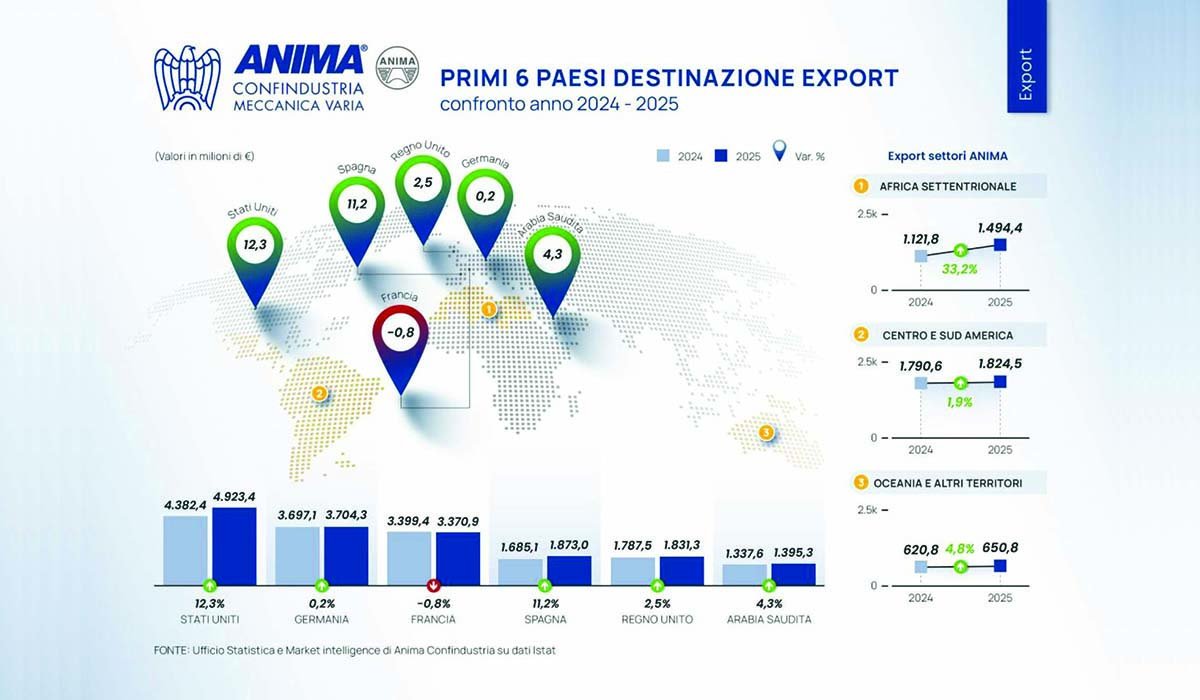
A significant share of the export surplus is concentrated in the United States , which confirmed its position as the leading destination for Anima mechanical engineering in 2025 with over 4.9 billion euros (+12.3%), but the recent announcement by the White House of additional duties on aluminum and steel articles, some copper articles and some aluminum and steel derivatives could have a strong impact on the export of mechanical engineering represented by Anima Confindustria.
"The 2025 growth reflects a geographical redistribution of demand, with concentration in a few key markets and weakening in others," says Pietro Almici , president of Anima Confindustria. "The data must therefore be interpreted carefully, especially in light of the current macroeconomic environment, characterized by declining industrial expectations and rising costs, but above all by a climate of uncertainty prevailing internationally. The situation in the Gulf countries, a region of great interest for the Italian mechanical engineering industry, could suffer a significant setback; similarly, the recent White House announcement of changes to tariffs on copper, aluminum, and steel products could have a significant impact on our exports."
The sentiment among mechanical engineering companies is moving in this direction: according to the latest survey of member companies, approximately 40% of the sample expects a decline in exports in the first half of the year. Companies are particularly concerned about the future of the American market and the current situation in the Middle East.
Precisely because 2025 confirmed the strength of mechanical engineering exports, the current international scenario is even more critical; however, the sector maintains a structured presence and competitive capacity on global markets, starting with the Persian Gulf area, also through results such as the Memorandum signed between Anima and the Italian-Arab Chamber of Commerce to strengthen internationalization opportunities. Internationally, tensions in the Gulf countries therefore pose a high risk, both for exports and for the potential increase in energy costs —up to €21 billion for Italian companies (Confindustria Flash Economic Outlook, April 2026).
The EU27 countries remain the main market for mechanical engineering, as highlighted by analyses by the Statistics Office of Anima Confindustria: +2.4% and over €17 billion. Germany remains Europe's leading trading partner, with €3.7 billion and essentially stable (+0.2%) through 2024. France declined by 0.8%, while Spain recorded the greatest growth (+11.2%). Poland (€1.16 billion and +4.3%) climbs to seventh place in the Italian export rankings, surpassing China (-14.1%).
Considering Asia and the Middle East , exports are concentrated in a few high-value countries and strategic categories. Saudi Arabia rises to the top destination market, with €1.4 billion in exports and a 4.3% increase compared to 2024. China falls to €1.13 billion, and Singapore collapses (-46.5%), while the greatest growth in 2025 is concentrated in the United Arab Emirates (+27.1%) and Qatar (+18.1%).
Elsewhere in the world, Algeria (+70.6%) and Australia (+10.8%) saw significant growth, joining the top 20 destinations for Italian mechanical engineering. South America also remains a key region. Further strengthening Anima's strategic positioning in South America are: the launch of the EU-Mercosur agreement on May 1st, strongly supported by the government and intended to consolidate one of the largest integrated trade areas globally, with the progressive elimination of tariffs on 91% of products; the Confindustria mission to Argentina and Brazil from September 7th to 11th on industry and energy; Anima's joint participation in the "ROG.e Energy" trade fair; and the Memorandum of Understanding with Adimra (the Association of Metallurgical Industrialists of the Argentine Republic) signed in June 2025.
Finally, turning to imports , Germany remains the leading country of origin with 3.99 billion euros (+9.4%), followed by China and the United States . In terms of geographical areas, the EU27 absorbs the predominant share (56.4% of the total), while East Asia emerges as the second largest supply hub (Processing by the Anima Statistics & Market Intelligence Office based on Istat data).
" The mechanical engineering industry today finds itself in a very critical and uncertain phase , in which export growth is insufficient to offset the structural issues related to energy costs and the lack of a real industrial policy," concludes President Almici. "In a scenario that remains completely unpredictable , a reduction in energy costs is essential, and it is a priority for European institutions to put manufacturing back at the center , to prevent the current tensions from leading us toward a deeper industrial crisis."
ANIMA Confindustria is the trade organization within Confindustria that represents companies in the mechanical and related sectors, a sector that employs 224,006 people, generates a turnover of €59.1 billion, and accounts for approximately 60% of exports (2025 forecast by the Anima Research Office). The major sectors represented by ANIMA are: construction and infrastructure; material handling and logistics; food production; energy production; industrial production; and safety and environment.
Not just another marketplace: a-z maschinenwelt launches its own online auctions of used machinery w
On auctionz.de, the Weinstadt-based machinery dealer will be auctioning exclusively machines he owns from September 2026 – the first auctions will end at the beginning of October. AZ Maschinenwelt GmbH, headquartered in Weinstadt near Stuttgart, is launching auctionz (auctionz.de), its international online auction platform for used industrial and production machinery, in September 2026. Unlike most auction portals, only company-owned machinery and equipment will be auctioned. With auctionz, AZ Maschinenwelt has consciously chosen not to act as a marketplace or intermediary for third-party sellers, remaining what it has always been: a machinery dealer with a personal relationship with its customers, who is personally responsible for its goods. The first auctions will close in early October 2026. TRANSPARENCY INSTEAD OF ANONYMITY Many auction platforms in the machinery trade operate as mere intermediaries. Buyers often don't know exactly who is behind the goods they're offering or who is responsible for any technical questions they may have. At auctionz, things are different: every machine offered has been personally inspected by the team, examined, photographed, and truthfully described. From the initial technical question to purchase and payment, through to disassembly, loading, customs documentation, and export management, buyers have a direct contact. Thomas Reichelt, managing director, AZ Maschinenwelt GmbH: The market doesn't need another platform where anyone can list anything. And that's exactly what we don't want to be. We remain machinery dealers: we buy the goods ourselves, we know our machines, and we personally answer for what we offer. With auctionz, we're simply using a new means to market machinery even more transparently and internationally—without sacrificing personal responsibility. Adnan Saeed, founder and managing director, AZ Maschinenwelt GmbH: We don't sell any machine we haven't seen with our own eyes. Thomas or I personally stand in front of every machine before it goes to auction. What we photograph and describe corresponds to the condition the buyer will find—that's what we want to be judged on. INSOLVENCY, CESSATION OF BUSINESS AND SURPLUS MACHINES The machines up for auction originate from insolvencies, company and plant closures, restructurings, and excess inventory, as well as from the purchase of entire machine parks and production sites by AZ Maschinenwelt. The offering is aimed at medium-sized manufacturing companies, international machinery dealers, workshops, and industrial end customers worldwide.• Conventional machine tools• CNC machines and machining centers• Complete production plants• Metalworking• Woodworking• Plastics technology• Measurement technique• Compressors and compressed air• Warehouse and factory logistics• Workshop and company equipment HOW AUCTIONS WORK Auctions are conducted entirely digitally. Upon request, an automated bidding agent will raise the bid up to the maximum amount set; if bids are placed shortly before the closing time, the auction is automatically extended. A 9 percent commission is added to the hammer price. Any disassembly and loading costs are shown separately and transparently, as are any transferred cost items, without any additional margin. Even after the auction has been awarded, AZ Maschinenwelt provides comprehensive support to its customers, upon request including the entire handling of BAFA paperwork, export, and customs documents, up to the machine's collection. PLATFORM LAUNCH: September 2026 FIRST AUCTIONS END : Early October 2026 FORMAT : Fully digital online auctions with bidding agent and automatic extension CONDITIONS : 9% commission on the hammer price; dismantling/loading as costs transferred without markup SERVICES : Personal contacts; BAFA, export and customs management up to collection URL : www.auctionz.de WHO IS AZ MASCHINENWELT? AZ Maschinenwelt was founded in 2011 by Adnan Saeed and has operated as a limited company since 2025, headquartered in Weinstadt near Stuttgart. The company trades in used industrial and production machinery internationally, handles complete company liquidations, and handles disassembly, logistics, and warehousing. Approximately 20 employees work at the Weinstadt (administration) and Weilheim an der Teck (warehouse and showroom) locations; sales are conducted in Europe, North America, Asia, and other global markets. Since January 2025, Thomas Reichelt has led the company alongside Adnan Saeed. Further information is available at www.az-maschinenwelt.com and www.auctionz.de.
 Industriale.it certification